
Shillong Morning Teer: History, Rules, Results and Complete Guide
Shillong Morning Teer is an archery-based number game associated with Shillong and the Khasi Hills region of Meghalaya, India. It is different from an ordinary lottery because its result is connected to a real archery session. Skilled archers shoot arrows at a traditional target, the successful hits are counted, and the final two digits of the total are used to produce the result.
For people who follow the game regularly, terms such as Shillong Morning Teer result, Morning Teer number, Shillong Teer result, First Round (FR), Second Round (SR), Morning Teer previous result, and Morning Teer chart are commonly used when searching for information.
At the same time, it is useful to understand that historical numbers and statistical patterns do not provide a guaranteed way of predicting a future result. The most reliable approach is to treat previous results as historical information rather than as certainty about what comes next.
What Is Shillong Morning Teer?
Shillong Morning Teer refers to a morning session of the Teer tradition associated with Meghalaya. At its foundation is traditional Khasi archery. Rather than selecting a number through a computer-generated lottery mechanism, the outcome is connected with the number of arrows that successfully strike the target.
The Meghalaya government regulates arrow shooting and the sale of Teer tickets through the Meghalaya Regulation of the Game of Arrow Shooting and the Sale of Teer Tickets Act, 2018. The legislation defines arrow shooting as a game using traditional bows and arrows and provides a regulatory framework for licensed activities. (Meghalaya Government Portal)
This legal framework is important because it distinguishes the regulated Teer activity from unofficial websites, informal number claims, or unrelated gambling operations.
The Traditional Archery Connection
Archery has a long association with Khasi culture. The modern Teer system combines this traditional sporting activity with a number-based result format.
The archers are trained to shoot repeatedly toward a fixed target. Their accuracy, timing, concentration, and consistency are important parts of the actual sporting event.
This is one reason Shillong Teer has remained distinctive. The number displayed as the result is not simply selected from a machine. It is derived from the total number of successful arrow hits recorded during the shooting process.
The government rules also specify requirements relating to the number of shooters, arrows, targets, shooting distance, and the time allowed for a round. For example, the rules provide for between 30 and 50 shooters and specify that the total number of arrows used in each round must fall within the prescribed range. (Taxation Department of Meghalaya)
How Does Shillong Morning Teer Work?
The basic process can be explained in several stages.
1. Archers prepare for the session
The participating archers gather at the designated shooting area with their bows and arrows. The equipment and shooting arrangements follow the rules applicable to the licensed event.
2. Arrows are shot at the target
The archers shoot a large number of arrows toward the traditional target. Accuracy is essential because only successful hits contribute to the total used for calculating the result.
3. Successful arrows are counted
After the shooting round, the arrows that have struck the target are counted. The number of successful hits forms the basis of the round’s result.
4. The final two digits form the result
The commonly described Teer result system uses the last two digits of the total successful hits.
For example, if the counted total were 1,247, the corresponding two-digit result would be 47.
Similarly, if the total were 892, the result would be 92.
This explains why Teer results are normally displayed as two-digit numbers ranging from 00 to 99.
What Are FR and SR in Morning Teer?
People who follow Shillong Morning Teer will often see the abbreviations FR and SR.
- FR means First Round.
- SR means Second Round.
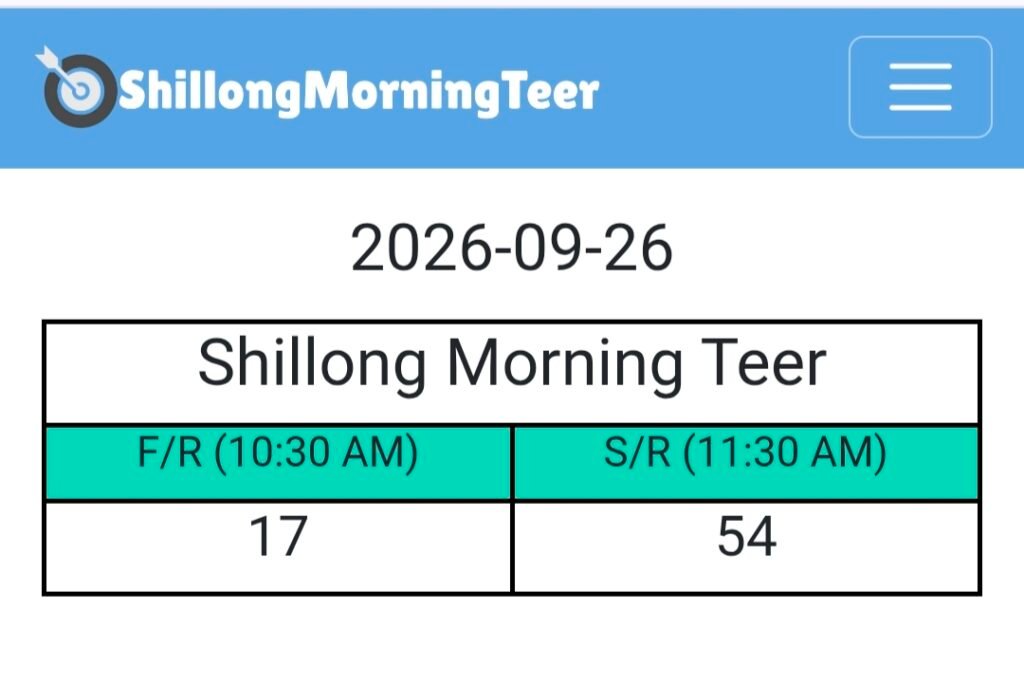
The two rounds produce separate two-digit results. Therefore, a result table may look like this:
| Date | FR | SR |
|---|---|---|
| 2026-09-26 | 17 | 54 |
The numbers in such a table are historical results, not predictions.
It is important to distinguish the morning session from other Teer sessions associated with Shillong or other locations in Meghalaya. Different games may have different schedules, organizers, and result records. When checking a result, readers should make sure that they are looking at the correct game and date.
Shillong Morning Teer Result
The Shillong Morning Teer result is one of the most frequently searched terms connected with the game. People generally want to know the First Round and Second Round numbers after the shooting has taken place.
Because online result pages can sometimes publish different information, it is sensible to compare an online result with the authorized result announcement or official counter where possible.
Government rules require licensed operators to publicly declare the lucky numbers at the place of shooting within the prescribed period after the completion of the game. The rules also specify requirements concerning licensed bookmakers and government-authorized tickets. (Taxation Department of Meghalaya)
Therefore, an online page should be treated as a convenient information source, while the officially declared result remains the important reference.
Shillong Morning Teer Previous Results
Previous results are useful for maintaining a historical record of the game.
A Morning Teer previous-result chart can contain the date, First Round number, and Second Round number. For example:
| Date | First Round | Second Round |
|---|---|---|
| Day 1 | 53 | 98 |
| Day 2 | 38 | 15 |
| Day 3 | 67 | 54 |
| Day 4 | 01 | 90 |
| Day 5 | 17 | 54 |
These figures illustrate the format of a historical chart rather than suggesting a future pattern.
Historical archives can be useful for researchers and regular followers who want to organize past numbers by date, month, or year. Some online archives maintain records going back many years. (Shillong Teer Analytics)
What Is a Morning Teer Chart?
A Morning Teer chart is simply a structured way of arranging historical numbers.
A basic chart may include:
- Date
- First Round
- Second Round
- House digit
- Ending digit
- Previous result
- Number frequency
More detailed charts may group numbers by month or year.
For example, a result of 47 has a house digit of 4 and an ending digit of 7. A result of 82 has a house digit of 8 and an ending digit of 2.
These classifications make historical data easier to organize and study.
However, chart analysis should not be confused with a guaranteed prediction system. A number appearing several times in historical records does not establish that it must appear again.
What Does “Common Number” Mean?
The phrase Shillong Morning Teer common number is often used when people discuss historical frequency.
Generally, a common number means a number that has appeared repeatedly within a selected historical dataset. For example, if a particular two-digit number appears several times in a month’s records, someone may describe it as a commonly occurring number.
But frequency is a description of past data. It does not prove that the same number will occur in the next round.
The same principle applies to terms such as:
- Hot number
- Cold number
- Common number
- House number
- Ending number
- Previous number
- Dream number
- Lucky number
These expressions are commonly found in Teer-related discussions, but they should not be treated as mathematical guarantees.
Why Do People Follow Previous Results?
There are several reasons people maintain Morning Teer result charts.
First, historical records make it easier to check an earlier result. Someone may want to confirm the number from yesterday, last week, or a particular month.
Second, researchers and enthusiasts may want to organize results into tables and examine how frequently different numbers appeared.
Third, historical records provide information about the development and continuity of the game.
A well-maintained archive is therefore useful even when the numbers are not used for prediction.
Shillong Morning Teer and Meghalaya’s Regulation
Shillong Teer operates within a regulatory framework established by Meghalaya.
The Meghalaya Regulation of the Game of Arrow Shooting and the Sale of Teer Tickets Act, 2018 was enacted to regulate arrow shooting and the sale of Teer tickets. The Act applies throughout Meghalaya and sets out definitions and provisions concerning the game and licensed activity.
The accompanying rules also specify conditions for licensed arrow-shooting activities, including requirements related to shooters, arrows, targets, shooting distance, and the operation of licensed activities. (Taxation Department of Meghalaya)
Readers should therefore distinguish between the regulated game and unofficial websites or social-media accounts claiming to provide guaranteed numbers.
Shillong Morning Teer Timings
Timing information can vary between different Teer sessions and online sources, so readers should verify the schedule for the specific Morning Teer event they are following.
Some current online result pages list a morning First Round and Second Round at approximately one-hour intervals, while other Shillong Teer sources describe different sessions and timings. (teer.club)
For this reason, it is better not to assume that the timing of one Shillong Teer session automatically applies to every Teer game in Meghalaya.
When checking a result, confirm:
- The correct date
- The correct Teer session
- First Round or Second Round
- The official result announcement
- Whether the source is authorized or simply an independent information website
Difference Between Shillong Morning Teer and Regular Shillong Teer
The main difference is the session being followed.
Shillong Morning Teer refers to the morning session, while Shillong Teer is also used more broadly when discussing other Shillong archery sessions.
There are also other Teer games in Meghalaya, including games associated with places such as Khanapara and Juwai. A number from one game should never automatically be treated as the result of another game.
This distinction is especially important when searching online because several websites publish multiple Teer result tables on the same page.
Can Previous Results Predict the Next Number?
Previous results can be analyzed, but they cannot guarantee a future result.
Suppose a number appears five times during a particular historical period. That tells us that it appeared five times in that dataset. It does not establish that it is more likely to appear in the next round.
Likewise, a number that has not appeared for a long time is not automatically “due.”
This is why historical charts should primarily be understood as records of past results rather than guaranteed prediction tools.
How to Read a Morning Teer Result Page
A simple result page can usually be understood in a few steps.
Step 1: Check the date.
Step 2: Confirm that the page is showing Shillong Morning Teer rather than another Teer game.
Step 3: Find the FR result.
Step 4: Find the SR result.
Step 5: Compare the numbers with the official declaration where possible.
This simple process reduces the possibility of confusing one game’s result with another.
Importance of Responsible Participation
Teer involves money when tickets or betting participation are involved, so readers should approach it responsibly.
No website, chart, historical pattern, social-media post, or claimed “sure number” can guarantee a future result.
People should also be aware of scams involving fake result websites, unauthorized ticket sellers, or individuals claiming to have secret information about upcoming numbers.
A responsible information page should focus on explaining the game, documenting historical results accurately, and avoiding claims that a particular number is certain to win.
Conclusion
Shillong Morning Teer combines traditional archery with a two-digit result system and has become a distinctive part of Meghalaya’s Teer culture. Its results are connected with actual arrow-shooting activity, with successful hits counted and the final two digits used for the round result.
For readers searching for Shillong Morning Teer result, Morning Teer number, Shillong Morning Teer previous result, Morning Teer chart, FR, SR, or common numbers, understanding the underlying process is more useful than simply looking for predictions.
The most important points are simple: check the correct session, confirm the date, understand the difference between FR and SR, use historical charts as records, and verify results through reliable or authorized sources.
Shillong Teer’s connection with traditional Khasi archery is what makes it different from an ordinary number draw. The sporting activity, the organized counting process, and Meghalaya’s regulatory framework all form part of the system.
